

Company overview
LetsGetChecked is a global healthcare company enabling patients to manage their health from home with at-home testing, genetic sequencing, virtual consultations, and medication delivery. Supporting this end-to-end model requires highly reliable software that's always ready for every click, call, and delivery.
When pandemic-driven demand made scaling urgent, Chief Software Engineer Javier de Vega Ruiz faced a challenge that many engineering leaders know well: the code wasn't the bottleneck. The way the organization operated was.
Key wins
By adopting Cortex as their Engineering Operations Platform, LetsGetChecked transformed how their engineering organization ran. They aligned platform engineers, SREs, and developers around shared standards, centralized visibility, and drove continuous improvement. The impact:
67% reduction in Mean Time to Restore
2x deployment frequency in months (from 17 to 32 deployments per week)
Accelerated a critical Kubernetes migration by 8 months
On track for 75% reduction in hosting costs
The challenge: Growth exposed operational gaps
When the engineering team grew beyond 15 developers, LetsGetChecked's monolithic architecture began to slow them down. Too many engineers were fighting to merge code into the same few repositories, creating bottlenecks in the deployment pipeline.
The solution was a shift to microservices. Splitting existing services and creating new ones allowed teams to work in parallel and regain speed. But as the number of services grew from 15 to 100 in under a year, a new challenge emerged.
The technical architecture had scaled. The operational model hadn't.
No one knew who owned what. Incidents resulted in Slack blasts to 100+ engineers. Compliance requirements added stakes to every deployment. Migrations had no coordination layer. Teams were working hard, but the organization wasn't operating as one.
"We saw services become too big and too slow, hurting our ability to keep up with the innovation our user base required," Javier says. "But in healthcare, with regulations like HIPAA and HITRUST, you can't sacrifice compliance for speed."
Healthcare regulations and the risks of unreliable code have traditionally capped the pace of innovation in healthtech. This a core problem that Engineering Operations exists to solve. The chaos wasn't a code problem, it was an organizational one. Scattered ownership data, siloed teams, no shared definition of "good," and no system for driving improvement at scale.
The approach: Engineering operations as the operating model
Javier and his team needed a new operating model. One that gave every team clarity on what good looked like, made it easy for developers to do the right thing, and created a shared engine for continuous improvement. He adds, "Whether you're migrating systems or building a service, everything should include a step-by-step plan for developers."
They turned to Cortex to serve as the operational backbone for the entire engineering organization, connecting platform engineering, TechOps, and developers around three core capabilities:
1. Centralized visibility: One source of truth across the stack
The first step was eliminating the blind spots. With Cortex's Catalog auto-syncing ownership, dependencies, and on-call data across the stack, LetsGetChecked finally had a single source of truth for their engineering organization.
TechOps could find the right owner in seconds. Developers could see the full picture of what they owned. Leaders could identify gaps in coverage before they became incidents.
"One of the biggest improvements we've seen since implementing Cortex is in our Mean Time to Restore; which we were able to reduce by 67%. Being able to quickly find up-to-date service information, and have requests immediately prioritized is a small operational change that has enormous impact."
— Javier de Vega Ruiz, Chief Software Engineer, LetsGetChecked
2. Automated standards: Scorecards that drive a culture of improvement
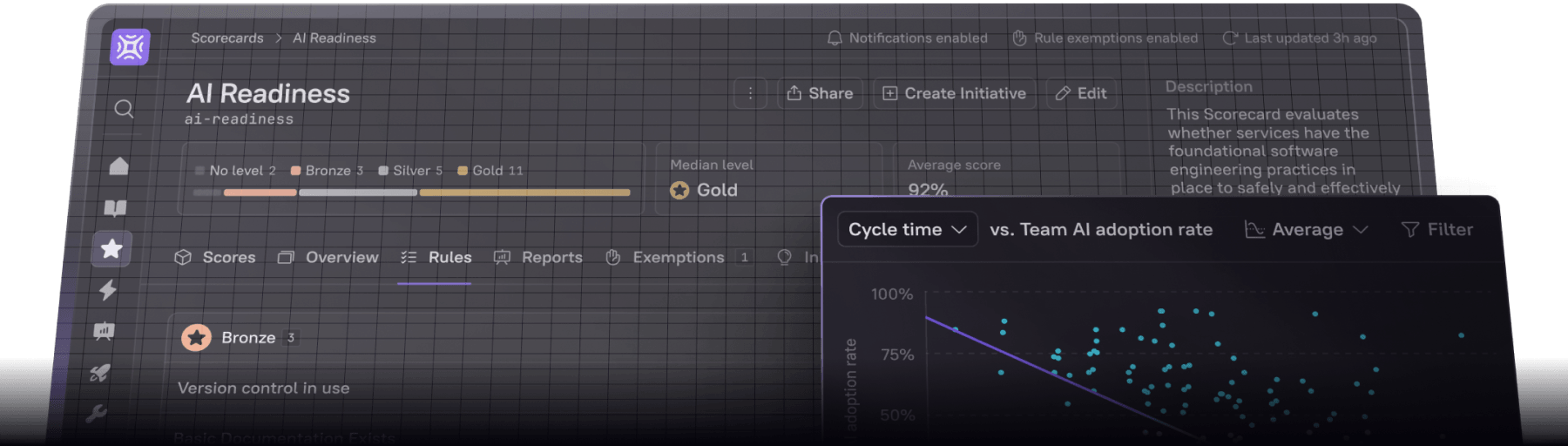
LetsGetChecked uses Cortex Scorecards to define shared standards for service onboarding, maturity, and deployment frequency, and make progress visible across every team.
This is Engineering Operations in practice: not mandating standards from above, but embedding them into the workflow so the right behavior becomes easy.
"There's a gamification element in Cortex where teams can compare themselves to one another. Anyone can see straight away who's improving, who's falling behind, and who needs more support."
— Javier de Vega Ruiz, Chief Software Engineer, LetsGetChecked
The deployment frequency Scorecard set organization-wide benchmarks, and teams responded. LetsGetChecked hit their year-long deployment goal in months, going from 17 to 32 deployments per week.
"With Cortex, we set a year-long goal of hitting 25 deployments per week. Within months, we went from 17 per week to 32."
— Javier de Vega Ruiz, Chief Software Engineer, LetsGetChecked
3. Golden paths: Turning migrations into operational initiatives
Some of the highest-leverage Engineering Operations work happens at the organizational level. This looks like driving complex, multi-team migrations on strict timelines without losing momentum on day-to-day delivery.
LetsGetChecked used Cortex Initiatives, Scaffolding, and custom alerting to coordinate their Kubernetes migration: moving services off EC2 and Windows to a containerized Linux model. The result was a projected 24-month migration completed in just 16 months. They captured hosting cost savings and developer productivity improvements 8 months ahead of schedule. Monthly infrastructure costs are set to drop by 75%.
"In the case of our Kubernetes migration, the ability to drive timely action cut our projected timeline from 24 months down to 16, enabling us to capture savings and productivity benefits 8 months earlier than expected."
— Javier de Vega Ruiz, Chief Software Engineer, LetsGetChecked
Conclusion
LetsGetChecked didn't just ship faster or reduce incidents. They built an Engineering Operations foundation, creating a shared operational function that gives platform engineers, SREs, and developers common standards and a system for improvement.
For Javier, that cultural shift is the real transformation.
"The finish line isn't merging a PR, but ensuring software you own actually works in production. Collecting telemetry, setting up alerts, and owning the fix. Cortex brings all of the inputs for this work into one space so devs can really take ownership over what they build, without slowing them down."
In an industry where reliability is life-critical and the cost of operational chaos is measured in patient outcomes, LetsGetChecked made a clear choice: execute as a cohesive group to help engineering get better at serving customers.
Ready to build your Engineering Operations practice? See how Cortex can help your organization operate as one.